
You’ve tried the fiber. You’ve chugged the water. You’ve sat on the toilet so long your legs went numb and your phone battery died. Yet here you are, still feeling like your digestive system decided to take an unannounced vacation.
Here’s what nobody tells you: sometimes the secret to getting things moving isn’t more straining on the toilet—it’s what you do before you get there. Specifically, how you lie down.
Your body isn’t just a tube with food going in one end and coming out the other. The way you position yourself affects gravity, pressure on your intestines, and whether your pelvic floor muscles are clenching like they’re guarding state secrets or actually relaxing enough to let things pass.
These lying positions won’t create stool out of thin air. But if you’ve got something waiting to move and your gut just needs a nudge, the right position can be the difference between another frustrating bathroom session and sweet, sweet relief.
Quick positions to try first for immediate relief
If you already feel the urge—or that heavy, “something’s definitely in there” sensation—these positions can sometimes stimulate a bowel movement within minutes. Think of them as your first-response toolkit when constipation strikes. Traditional yoga poses can stimulate bowel movements by compressing and massaging the abdomen, making it easier to pass stool.
Try each position for 30 to 90 seconds. You might feel gentle pressure, some rumbling, or gas shifting around. That’s normal and usually means things are starting to move.
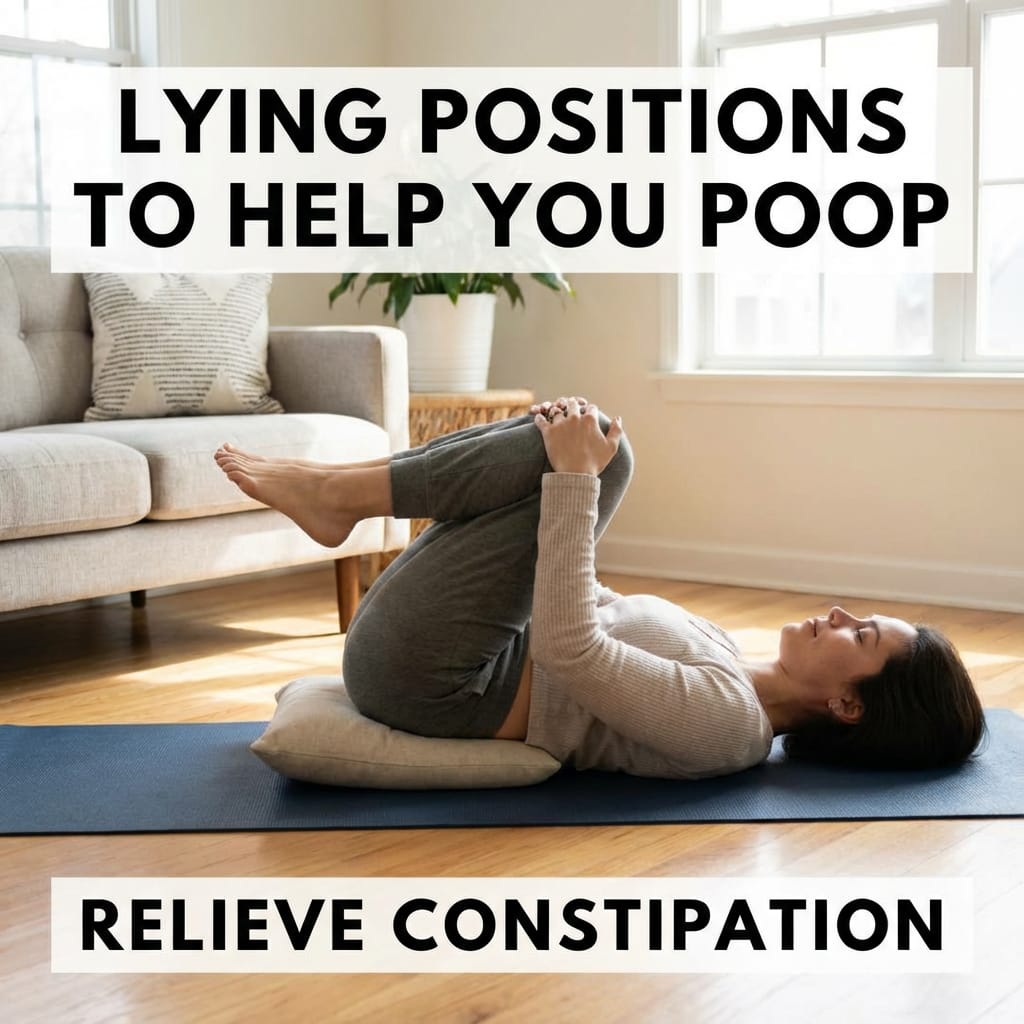
- Knees-to-chest on your back (Wind-Relieving Pose): Lie flat on your bed or floor. Pull both knees toward your chest and wrap your arms around your shins. Let your lower back press into the surface beneath you. This pose, known in yoga as Wind-Relieving Pose, compresses the abdomen to stimulate bowel movements and help you pass stool. For added comfort and support, place a pillow under your knees while on your back to provide better lumbar support and relax your pelvic floor muscles. Hold for 60 seconds while breathing slowly through your belly. This compresses the large intestine and helps trapped gas find its way out.
- Supine twist: Stay on your back with your arms out to the sides like a T. Bend both knees, feet flat. Drop both knees to your left side while keeping your shoulders down. Hold 30 to 60 seconds, then switch to the right. The gentle twist massages your intestines and can shift stool along the digestive tract. You can also place a pillow under your knees for additional lumbar support and to help relax the pelvic floor.
- Child’s pose on the bed: Kneel on your mattress, then sit your hips back toward your heels and fold your upper body forward. Rest your forehead on a pillow and let your arms extend in front of you or rest alongside your body. This position relaxes the pelvic floor and puts gentle pressure on your abdomen.
- Left side lying with knees bent: Lie on your left side with a pillow under your head. Bend your knees slightly toward your chest—not a full fetal curl, just a comfortable angle. This position uses gravity to help contents move through your colon toward the exit.
Stop and change position if you experience sharp pain, dizziness, or sudden intense cramps. Mild discomfort and gas movement are fine; anything that feels wrong isn’t worth pushing through.

Why lying positions can help you poop
Your digestive system isn’t just about what you eat—it’s about physics. Gravity, pressure, and muscle tension all play a role in whether stool moves smoothly through your intestines or sits there like a stubborn houseguest who won’t leave. Scientific research published in the American Journal of Physiology-Gastrointestinal and Liver Physiology highlights how gut motility and body positioning can impact digestion and bowel movements.
Here’s what’s actually happening inside you:
- The anorectal angle matters: Your rectum and anal canal don’t form a straight line. A muscle called the puborectalis loops around your rectum and creates a kink—helpful for not pooping your pants, less helpful when you’re actually trying to go. Certain lying positions can partially straighten this angle, making it easier for stool to pass. As explains Dr. Sonpol, adjusting your position can help relax the puborectalis muscle and facilitate smoother elimination.
- Gravity pulls in different directions: When you’re upright, gravity helps move stool downward toward your rectum. When you lie down, gravity works sideways instead. Lying on your left side, for example, helps contents in your ascending colon (right side of your belly) move across and down toward the descending colon and rectum. The small intestine, which is responsible for nutrient absorption and moving food from the stomach onward, also benefits from this position, as lying on the left side may facilitate the movement of food from the stomach into the small intestine.
- Abdominal pressure shifts: Drawing your knees toward your chest or twisting your torso creates gentle mechanical pressure on your intestines. This can stimulate peristalsis—the wave-like contractions that push food and waste through your gi tract.
- Pelvic floor relaxation unlocks the exit: A tight pelvic floor can literally hold stool in. Lying positions that allow your hips to open and your lower body to relax help those muscles soften, making bowel movements easier.
- These are like gentle stretches for your gut: Think of lying positions as yoga for your intestines. They’re low-impact ways to nudge your digestive health in the right direction when you’re too tired, bloated, or uncomfortable for full physical activity.
Lying on your left side makes a morning bowel movement more likely, as supported by a systematic review and meta-analysis, which found that left-sided sleep position can reduce reflux symptoms and improve digestive comfort. Lying positions won’t magically create stool. But they can help move existing stool and trapped gas along—especially when combined with slow, diaphragmatic breathing that tells your nervous system it’s safe to relax and release.
Best lying positions to stimulate a bowel movement
These are the core positions to try when you’re constipated or feeling backed up. Each one targets slightly different parts of your abdomen and creates different angles in your digestive tract. When lying on your back, also known as the supine position, consider placing a pillow under your knees to support the lower half of your body—including your hips, knees, and lower back—for better spinal alignment and comfort. Lying on your back with elevated knees encourages total muscle relaxation and allows waste to move more freely, which can help relieve constipation.
Spend about 5 to 10 minutes total working through 2 or 3 of these positions. Hold each for 20 to 30 seconds and repeat 3 to 5 times before moving on. For stretches like the supine twist, remember to switch to the opposite side to ensure balanced muscle engagement. In some stretches, lifting or positioning one leg can help deepen the stretch and target the pelvic floor or lower back for improved flexibility and bowel function.
Double knees-to-chest on your back
Lie flat on your back on a bed or yoga mat. Bend both knees and draw them toward your chest. Wrap your arms around your shins or clasp your hands just below your knees. Keep your head down or lift it slightly toward your knees if that feels comfortable. Your lower back should press gently into the surface. Hold for 20 to 30 seconds while taking slow belly breaths.
This is the gentlest option—good for beginners, older adults, or anyone with a sensitive back. The compression on your abdomen stimulates the intestines without requiring flexibility.
Reclined happy baby on the bed
Lie on your back. Bring both knees toward your armpits and grab the outer edges of your feet (or your ankles or shins if you can’t reach your feet). Let your knees drop out wide, wider than your torso. Your lower back stays on the bed. Gently rock side to side if that feels good.
This opens the hips more than knees-to-chest and creates additional space for the pelvic floor to relax. Hold for 20 to 30 seconds, rest, repeat.
Lying deep squat supported by pillows
Stack two or three firm pillows under your hips while lying on your back. Draw your knees toward your chest and let them fall slightly open. Your thighs should be angled close to your rib cage. You can hold behind your knees or let your arms rest at your sides.
This position more closely mimics a squatting posture—the gold standard for bowel movements—while keeping you lying down. The elevated hips help straighten the anorectal angle. Good for those comfortable with deeper stretches.
Side-lying fetal curl
Lie on your left side (left is generally better for digestion). Bend both knees and draw them up toward your chest—not all the way, just until you feel a gentle stretch. Rest your head on a pillow and place your left shoulder flat against the bed. You can put a pillow between your knees for comfort.
This position lets gravity helps move contents through the descending colon toward the rectum. It’s comfortable enough to hold for several minutes and works well as a bedtime position.
Elevated feet on the wall
Lie on your back with your buttocks a few inches from a wall. Extend your legs up the wall so your body forms an L shape. Your hips can stay flat or you can place a folded blanket under them. Let your arms rest at your sides, palms up. Relax your legs completely—the wall does the work.
This semi-inverted position uses gravity to shift abdominal contents and can be particularly helpful for bloating. Hold for 1 to 3 minutes. This one requires a bit more flexibility but provides gentle pressure without active effort.
Lying positions to relieve gas and bloating
Gas often comes before stool. When your intestines are full of trapped air, everything feels stuck. Positions that move gas can indirectly help you poop more easily by clearing the path.
The colon runs up your right side, across your upper abdomen, and down your left side before ending at the rectum. Because of this shape, lying on your left side typically helps gas (and stool) move toward the exit, while right side lying may help contents move from the cecum into the transverse colon.
Left side lying with pillow under waist
Lie on your left side with a pillow under your head and another thin pillow or folded towel under your waist. This creates a slight curve that opens the space between your hips and rib cage. Bend your knees slightly. Breathe slowly and deeply into your belly for 2 to 3 minutes.
This is often the best sleeping position for digestive issues and can ease constipation over time. It positions the stomach and intestines so gravity assists forward movement.
Gentle supine spinal twist
Lie on your back with arms out in a T. Bend your right knee and cross it over your body to the left side while keeping your right shoulder on the ground. Turn your head to look over your right shoulder. Hold 30 to 60 seconds, then switch sides.
The twisting motion gently compresses and then releases sections of your colon, which can help move gas bubbles along. You might hear some rumbling—that’s a good sign.
Figure-four stretch on your back
Lie on your back. Cross your right ankle over your left thigh just above the knee. Reach through and clasp your hands behind your left thigh or shin. Gently pull your left knee toward your chest. Hold 30 to 60 seconds, then switch legs.
This opens the hips and creates gentle abdominal pressure. It’s particularly useful if you’re feeling bloated in the lower belly.
Prone rest with pillow under hips
Lie face down on your bed with a thin pillow under your hips. Turn your head to one side. Let your arms rest wherever feels comfortable.
Stomach sleeping isn’t for everyone—it can strain the neck and lower back. But for those who tolerate it, the gentle pressure on the abdomen can help move gas. Keep sessions short (2 to 3 minutes) and avoid this position if it causes discomfort.
Breathing cues for all positions: Slow, diaphragmatic breathing through the nose helps release gas more effectively than shallow chest breathing. Let your belly expand on the inhale and soften completely on the exhale. This activates your parasympathetic nervous system and tells your gut it’s safe to relax.
Lying positions that relax the pelvic floor
A tight pelvic floor can “hold in” stool even when everything else is ready to go. If you tend to clench when you feel constipated—or if you’ve been straining on the toilet without success—these positions combined with conscious breathing can help those muscles finally let go.
The goal here is the opposite of Kegels. Instead of squeezing, you’re softening. Instead of holding tension, you’re releasing it.
- Supported butterfly on your back: Lie on your back with the soles of your feet together and knees dropped out to the sides. Place pillows or rolled towels under each thigh so your legs are fully supported and you don’t have to work to hold the position. Let your arms rest at your sides. Focus on letting the muscles around your anus and perineum completely relax. Hold for 2 to 3 minutes with slow belly breaths.
- Constructive rest position: Lie on your back with your feet flat on the floor, wider than hip-width apart. Let your knees knock inward so they rest against each other. This internally rotates your thighs and takes tension off the pelvic floor. Rest your hands on your belly to feel it rise and fall with each breath. Hold for 3 to 5 minutes.
- Side-lying with pillow between knees: Lie on your left side with your legs stacked. Place a fluffy pillow between your knees and another between your ankles if that feels comfortable. This keeps your hips level and prevents your top leg from pulling the pelvis out of alignment. The supported position allows pelvic muscles to fully relax.
Breathing practice for each position: Take 4 to 6 slow breaths per minute. Inhale for 4 counts, expanding your belly. Exhale for 6 counts, letting your belly fall and imagining your pelvic floor dropping down like an elevator descending. Repeat 6 to 10 breaths in each position.
These positions are especially helpful for people who notice they clench their jaw, hold their breath, or grip their buttocks when stressed. The body often holds tension in patterns—releasing one area can help release others.
Positions to try in bed vs. on the floor
Not everyone can (or wants to) get down on a yoga mat. The good news: most of these positions work in bed with minor modifications. Here’s how to adapt based on your situation and mobility.
Bed-safe versions
- Knees-to-chest: Works exactly the same on a mattress. If your bed is very soft, the support may feel different but the effect is similar. Place an extra pillow under your head if you have neck issues.
- Supine twist: Keep the twist smaller on a soft mattress—don’t let your knees drop as far to the side. The mattress provides less resistance, so you might not feel as deep a stretch. That’s fine; you’re still massaging the intestines.
- Side-lying fetal: This is actually easier in bed because you can use pillows freely. Place one between your knees, one under your waist, and one under your head. Get comfortable—this can double as your sleep position.
- Elevated feet: Use your headboard or a stack of firm pillows instead of a wall. Legs don’t need to be perfectly vertical; even a 45-degree angle provides benefit.
Floor versions (deeper stretch, more range)
- Knees-to-chest: On a firm surface, you can pull knees closer to chest and rock gently side to side to massage the lower back and abdomen.
- Happy baby: Easier to grab your feet and open your hips fully on a yoga mat where you won’t sink into the surface.
- Deep squat variation: On the floor, you can let your feet stay on the ground with knees bent deeply, then lie back and hold behind your knees. The firm surface provides better feedback.
Accessibility adaptations
Limitation | Modification |
|---|---|
Knee pain | Keep knees less bent; use rolled towels behind knees for support |
Hip replacement | Avoid crossing legs past midline; keep movements within safe range |
Limited spinal mobility | Reduce twist range; use more pillows to support the position |
Difficulty getting up from floor | Stick to bed-based positions or use a firm couch |
Simple props you probably have: Two standard bed pillows, a folded blanket or beach towel, a firm couch cushion, or a rolled-up yoga mat can all help modify positions for comfort and accessibility.
How long to hold these positions and when to use them
Timing matters. Your body has natural rhythms that affect when bowel movements are most likely to happen, and working with those rhythms makes these positions more effective.
Best times to try lying positions
- Within 30 to 60 minutes after breakfast: This is when the gastrocolic reflex is strongest. Eating food (especially a big meal) triggers contractions in the colon. Using lying positions shortly after eating can amplify this natural urge.
- When you first feel an urge: If you notice pressure or the sensation that something is “ready,” try a position or two before heading to the toilet. This can help move stool into the right spot.
- In the evening if you haven’t pooped all day: Before bed, spend 10 minutes working through 2 or 3 positions. Even if you don’t go immediately, you’re setting up conditions for a morning bowel movement.
- Before your last meal of the day: Some people find relief by doing positions before bedtime, then eating a light dinner to trigger overnight movement.
Duration guidelines
Element | Recommendation |
|---|---|
Individual position hold | 20 to 60 seconds |
Reps per position | 3 to 5 times |
Rest between positions | 15 to 30 seconds |
Total session time | 5 to 15 minutes |
Breathing tempo | 4 to 6 breaths per minute |
Sample “bathroom prep” routine
- Lie in knees-to-chest position for 60 seconds, repeat 3 times
- Move to supine twist, 30 seconds each side, repeat twice
- Finish with 2 minutes of left side lying with slow breathing
- Sit on the toilet for 5 to 10 minutes without straining
When to stop or switch positions
- Sharp pain (not just mild stretching sensation)
- Dizziness or lightheadedness
- Worsening cramps that don’t ease within 30 seconds
- Numbness or tingling in your legs
- Any position that just feels wrong for your body
If one position isn’t working, don’t force it. Switch to a different posture. Bodies are different, and what works for one person might not work for another.
Who should be cautious with certain lying positions
These positions are generally safe for healthy adults, but certain groups need modifications or should avoid specific movements altogether.
- Late pregnancy (third trimester): Avoid deep knees-to-chest positions that compress the belly. Avoid sleeping or lying flat on your back for extended periods as this can compress blood vessels. Side-lying with pillows is safest. Consult your doctor if constipation is severe.
- Severe hemorrhoids: Deep squatting positions and intense abdominal pressure may worsen symptoms. Stick to gentler options like side-lying and focus on relaxation rather than compression.
- Hernias (inguinal, umbilical, or abdominal): Avoid positions that significantly increase intra-abdominal pressure. Skip deep knees-to-chest and any position where you’re actively “bearing down.” Focus on side-lying and gentle twists.
- Recent abdominal or spinal surgery: Wait until cleared by your surgeon before attempting any lying positions beyond basic rest. Deep twists and hip flexion positions could stress healing tissues.
- Uncontrolled high blood pressure: Be cautious with legs-up-the-wall and other semi-inverted positions that temporarily increase pressure to the head.
- Glaucoma or recent eye surgery: Avoid inverted or semi-inverted positions where your head is below your heart.
- Spinal fusion or severe disc issues: Limit twist range and avoid deep flexion positions. Use extra pillow support and move slowly.
Red flags that require medical attention
See a doctor if you experience constipation lasting more than 2 to 3 weeks, blood in your stool, severe abdominal pain, unexplained weight loss, or fever alongside digestive symptoms.
Chronic constipation can sometimes signal underlying digestive conditions including gastroesophageal reflux disease or other issues affecting the digestive tract. Don’t rely on positional tricks alone if you regularly experience constipation that doesn’t respond to basic lifestyle changes.
Complementary habits that make these positions more effective
Lying positions work best as part of a bigger picture. Think of them as one tool in your gut health toolkit—effective on their own, but even better when combined with habits that support regular bowel movements.
In the toilet posture, using a footstool to elevate your knees while squatting helps straighten the rectum, mimicking a natural position for defecation and making it easier to poop.
Movement throughout the day is also important. Engaging in mindful exercises can help reduce stress and anxiety, which are often linked to digestive issues. Regular physical activity, such as yoga or walking, not only benefits digestion but also supports heart health.
Hydration
Aim for 8 to 12 cups of fluid per day unless you have a medical condition requiring fluid restriction. Dehydration is one of the most common causes of constipation. Your large intestine absorbs water from stool—if you’re not drinking enough, stool becomes hard and difficult to pass.
Fiber intake
Most adults need 25 to 30 grams of fiber per day. Increase slowly if you’re currently eating much less; sudden jumps can cause bloating and discomfort. Good sources include vegetables, fruits, legumes, and whole grains.
Regular “poop schedule”
Your bowels like routine. Try these positions at the same time each day—ideally 20 to 30 minutes after breakfast when the gastrocolic reflex naturally triggers colon contractions. Consistency trains your body to expect a bowel movement at certain times.
Toilet posture
When you do sit down, replicate squatting as much as possible:
- Use a footstool to raise your knees above your hips
- Lean forward slightly with elbows on knees
- Bulge your belly rather than straining from your chest
- Breathe slowly rather than holding your breath
This straightens the anorectal angle and reduces the need to strain—protecting your pelvic floor, preventing hemorrhoids, and making everything more efficient.
Movement throughout the day
Light walking, gentle yoga, or even simple stretching during the day can amplify the benefits of your lying positions at night. Physical activity stimulates peristalsis and keeps the digestive system moving. You don’t need intense exercise—a 20-minute walk after dinner can make a significant difference.
What to avoid sleeping positions-wise
If you have acid reflux or frequently feel heartburn at night, avoid sleeping on your right side and avoid lying flat immediately after eating. Left side sleeping with your upper body slightly elevated protects against stomach contents flowing back into the esophagus. Wait at least 2 to 3 hours after your last meal before lying down for sleep.
Your gut doesn’t need magic. It needs the right angles, a little gravity assist, and permission to relax.
If you’ve been struggling with constipation, bloating, or feeling like nothing moves no matter what you eat, try adding one or two of these positions to your morning routine. Start with knees-to-chest after breakfast, spend 5 minutes letting your body adjust, then head to the bathroom.
The goal isn’t to poop while lying down (that would be… inconvenient). It’s to set your digestive system up for success before you sit on the toilet.
Small changes, done consistently, add up. Your gut will figure out what you’re doing. And eventually, you’ll spend a lot less time staring at your phone on the toilet wondering why nothing’s happening.
Time to find relief—one position at a time.