
Nobody taught you how to poop. They covered reading, writing, and maybe even the birds and the bees—but the actual mechanics of sitting on a toilet? Apparently that was supposed to figure itself out.
Spoiler: for millions of people, it hasn’t.
If you’ve ever spent 20 minutes on the toilet wondering why this is so hard, or walked out feeling like you didn’t quite… finish the job, there’s a good chance your poop position is working against your body’s natural design. The way you sit, lean, and position your knees can mean the difference between a smooth, complete bowel movement and a frustrating session of straining that leaves you with numb legs and regret.
Let’s fix that.
Introduction to Optimal Bowel Movements
Look, good poop isn’t just about having a functioning gut—it’s basically the foundation of not feeling like garbage all day. When your body needs to clear out the trash, how smoothly that whole operation goes tells you a lot about what’s happening in your digestive world. And here’s the kicker: how you park yourself on that porcelain throne actually matters more than you think.
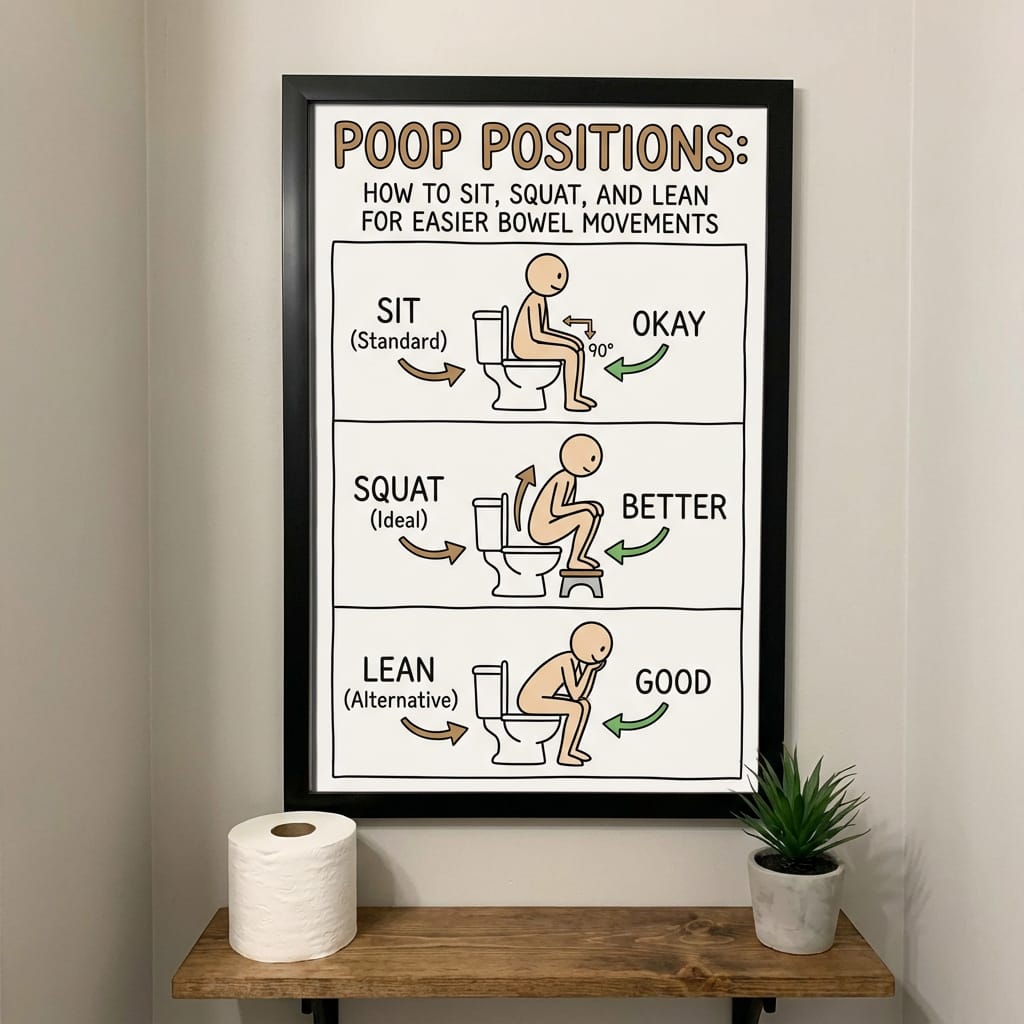
Using one of those little bathroom stools (yeah, the ones that make you look like you’re about to play patty-cake with your knees) helps you get into something closer to a squat—even on your regular toilet. This isn’t some wellness trend nonsense; this simple position change basically gives your intestines the green light to do their thing without having to navigate a bunch of unnecessary curves. The sweet spot for most people? Get those knees up above your hips, lean forward a bit like you’re telling your belly a secret, and just chill out.
This isn’t just about making your bathroom visits less of an Olympic event—it actually helps you avoid turning into someone who hasn’t pooped in three days and is starting to question their life choices. Make a couple tiny tweaks, like grabbing one of those stools and actually listening when your body sends you the “time to go” memo, and suddenly your bathroom routine goes from feeling like you’re negotiating with a stubborn toddler to something that just… works. Because honestly, how you sit matters just as much as whatever fancy fiber supplement you’ve been choking down.
Answer First: What Is the Best Poop Position?
The ideal position for most people is a supported squat: knees elevated above your hips, a slight forward lean, and a relaxed belly. This isn’t some weird wellness trend—it’s how your digestive system was designed to work.
Here’s the quick setup:
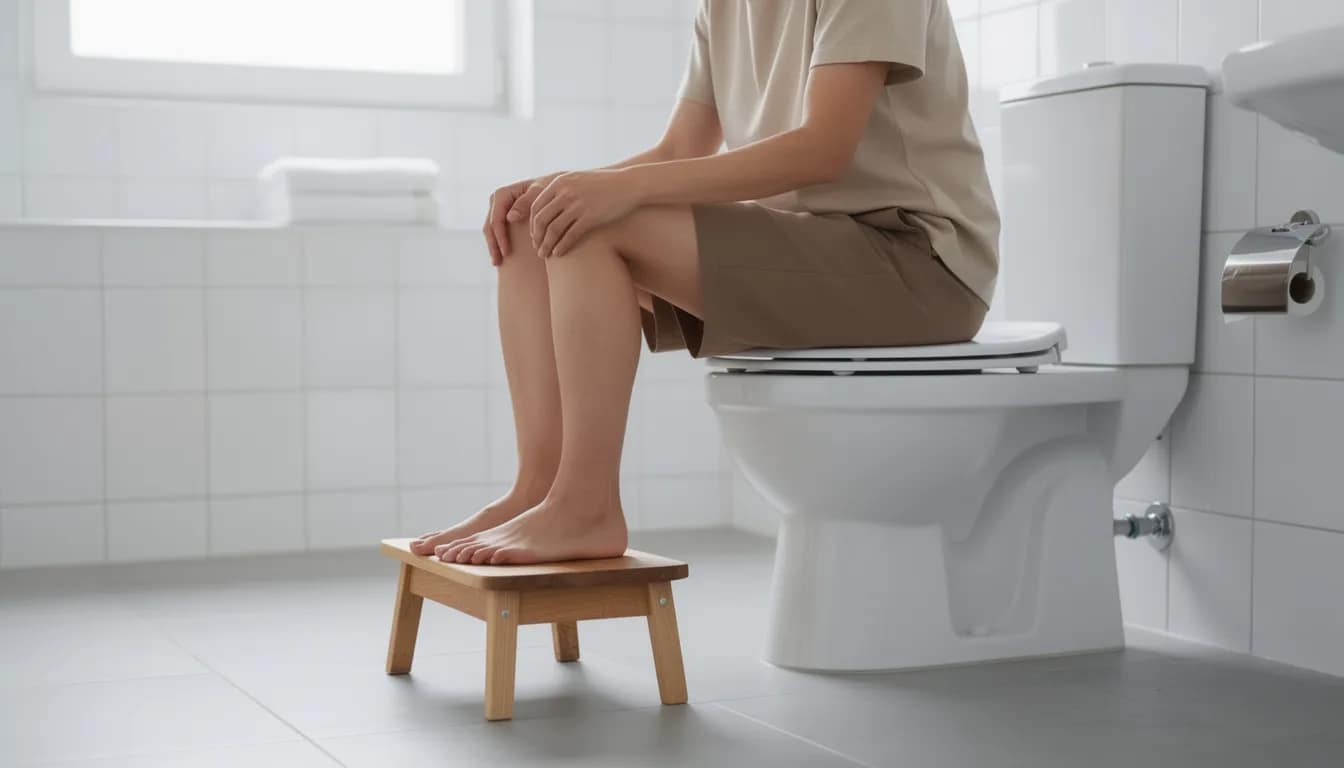
- Place your feet on a small stool (about 15-25 cm or 6-10 inches high)
- Position your knees higher than your hips
- Rest your elbows on your knees or thighs
- Lean forward slightly with a straight (not slumped) lower back
- Keep your mouth and belly relaxed—no clenching
This position helps straighten the anorectal angle, reduces straining, and can shorten toilet time to under 5-10 minutes for most people.
If you have hip, knee, or balance problems, you might need a modified version: a higher stool, a more upright posture, or grab bars for stability. The goal isn’t perfect form—it’s getting your body into a position where things can actually move.
Bowel Basics: How Pooping Works
Before we dive into positions, let’s talk about what’s actually happening inside your body when you need to go.
Stool forms in your large intestine (the colon), where water gets absorbed and waste becomes more solid. When it’s ready, stool moves into the rectum—the final holding area before exit. The rectum connects to the anus at what’s called the anorectal angle, which acts like a bend in a garden hose.
Here’s the key anatomy:
- The puborectalis muscle wraps around the rectum like a sling, creating a kink that keeps poop in when you’re not on the toilet
- At rest, this angle sits around 90-110 degrees—tight enough to maintain continence
- During defecation, the angle needs to straighten to about 100-120 degrees for stool to pass easily
- Your anal sphincters (internal and external) act as the final gatekeepers
Think of it this way: When you sit on a standard Western toilet with hips at 90 degrees, that garden hose stays kinked. When you squat over a pit latrine (or mimic that position with elevated knees), the hose straightens, and things flow with gravity instead of against it.
This is why someone in a squatting posture can often finish in minutes, while someone sitting upright might be straining for a quarter hour.
Common Poop Positions: Pros, Cons, and When to Use Them
Different toilet designs create different default poop positions. A Western pedestal toilet puts you in a seated position. Traditional squat toilets in parts of Asia and Africa put you in a deep squat. Bedside commodes split the difference.
Let’s break down the three main approaches: sitting, modified sitting, and full squatting.
Sitting on a Standard Toilet (Traditional Western Position)
This is how most people in Europe and North America have pooped for about 150 years, ever since indoor plumbing and pedestal toilets became the norm.
The position:
- Hips and knees at roughly 90-degree angles
- Feet flat on the floor
- Torso mostly upright
- No stool or elevation under the feet
The problem:
- This posture maintains a sharper anorectal angle (around 90 degrees)
- The rectum stays partially kinked
- Your rectal muscles have to work harder against that kink
- More pushing and straining is often required
Potential issues over time:
- Longer bowel movement duration
- Increased risk of hemorrhoids from repeated pressure
- Higher chance of anal fissures
- Associated with pelvic floor dysfunction and obstructed defecation
When it works fine:
- If you have soft, well-formed stool (Bristol Stool Chart types 3-4)
- No pelvic floor problems
- No history of constipation or straining
If you’re already dealing with constipation, hemorrhoids, or incomplete evacuation, this position is likely making things worse. Time to modify.
Sitting With Hips Flexed and Knees Raised (Supported Squat on a Toilet)
This is the best position for most people using a standard Western toilet. You’re essentially mimicking the benefits of squatting without ripping out your bathroom fixtures.
The setup:
- Feet on a small foot stool, stack of books, or yoga blocks
- Knees elevated so they’re higher than your hips (aim for 30-60 degrees of additional hip flexion)
- Lean forward slightly with elbows resting on your thighs
- Keep a neutral spine—not slumped, not rigidly straight
Common tools:
- Commercial toilet stools (the “Squatty Potty” style)
- Low step stools from any hardware store
- A sturdy storage box or crate
- Stacked books or magazines (finally, a use for those old phone books)
Benefits backed by research:
- A 2019 study found that using a defecation posture modification device reduced straining effort, discomfort, and bowel movement duration
- Participants reported more complete bowel movements
- Even a 35-degree knee angle with forward lean showed significant improvements
Why it works:
- Hip flexion relaxes the puborectalis muscle
- The anorectal angle straightens
- Gravity assists instead of fights you
- Less pressure needed from abdominal muscles
This position is often better tolerated by older adults or people with joint issues than a full squat, making bowel movements easier without demanding extreme flexibility.
Full Squatting (Traditional Squat Toilets or Floor-Level Pooping)
This is the original human poop position—the one we used for hundreds of thousands of years before chairs and thrones became a thing.
The position:
- Feet flat on the floor (or toilet footrests)
- Heels down if possible
- Hips deeply flexed, buttocks close to heels
- Torso inclined slightly forward
Why it’s biomechanically superior:
- Creates maximal hip flexion
- Produces the straightest anorectal angle
- Gravity and abdominal pressure work together efficiently
- Puborectalis muscle fully relaxes
The global perspective:
- Squat toilets remain common across Asia, Africa, and the Middle East
- Populations using these toilet designs report lower rates of constipation and hemorrhoid complications
- As urban areas in these regions adopt Western sitting toilets, digestive disorders are rising
Limitations:
- Challenging for people with knee osteoarthritis
- Unsafe for those with balance problems
- Difficult during late pregnancy
- Not ideal after recent hip or knee surgery
If you can’t manage a full squat (and honestly, most Westerners can’t), a potty stool on your standard toilet gives you most of the biomechanical benefits without the joint demands.
Step-by-Step: How to Get Into the Best Poop Position
Ready to try this on your next bathroom visit? Here’s your practical checklist.
Before you sit:
- Place your toilet stool in front of the toilet (don’t trip on it later)
- Make sure you have privacy and won’t be rushed
- If it’s cold, consider warming the seat—a tense body doesn’t poop well
Positioning your body:
- Sit on the toilet with feet placed hip-width apart on your stool
- Adjust until your knees are higher than your hips—this is the key
- Lean forward slightly and rest your elbows on your thighs
- Keep your lower back neutral, not rounded into a slump
- Let your shoulders relax down away from your ears
The relaxation part:
- Let your belly soften completely—no sucking in
- Unclench your jaw (you’d be surprised how many people poop with a clenched jaw)
- Breathe slowly through your nose or mouth
- Don’t hold your breath
Avoiding the strain game:
- Instead of pushing hard, exhale slowly like you’re blowing through a straw
- Imagine your pelvic floor dropping gently downward
- If your face turns red, you’re pushing too hard
- Think “open and release” rather than “squeeze and force”
Time limits matter:
- Aim to finish within 5-10 minutes
- If nothing happens after 10 minutes, stand up and walk around
- Drink some more water
- Try again when you feel the urge return
Sitting on the toilet scrolling your phone for 30 minutes isn’t patience—it’s a recipe for hemorrhoids.
Leaning Forward vs. Leaning Back: Does It Really Matter?
Yes, and here’s why.
Small changes in your trunk angle change how pressure distributes inside your abdomen and rectum. That matters more than you’d think.
The case for leaning forward:
- Pairs naturally with knees elevated to mimic a squatting position
- Increases intra-abdominal pressure in a helpful direction
- Recommended as the starting option by most pelvic health organizations
- Position: elbows on knees, chest angled slightly over thighs, neck neutral
How to do it right:
- Lean from your hips, not by rounding your shoulders
- Keep your spine relatively straight
- Don’t hunch or collapse your chest
- Think “hinged forward” not “curled into a ball”
When backward leaning might help:
- Late pregnancy, when forward leaning compresses the belly
- Severe lumbar spine pain that worsens with flexion
- Some specific pelvic floor dysfunction cases
The catch: Leaning backward can increase rectal bending in many people, making evacuation harder rather than easier.
The experiment:
- Try 2-3 sessions leaning slightly forward
- Then try 2-3 sessions leaning slightly backward
- Pay attention to ease of stool passage and straining
- Go with what works for your body
If you consistently feel like you need to lean backward to poop, this may indicate a pelvic floor coordination issue worth discussing with a professional.
Can You Make Yourself Poop Faster or “Instantly” with Position Alone?
Let’s be realistic: position helps, but it’s not magic.
You can’t conjure a bowel movement if there’s no stool ready in your rectum or no urge present. Position just makes an existing urge easier to complete—it doesn’t create demand where there is none.
Your best bet for speed:
- Go as soon as you feel the urge (don’t delay or “hold it”)
- The strongest urge often comes 30-60 minutes after breakfast (thanks to the gastrocolic reflex)
- Use the supported squat position with elevated knees
- Add gentle belly massage (circular motions, clockwise)
- Practice relaxed breathing
About stimulant laxatives and suppositories:
- Rectal suppositories typically work in 15-60 minutes
- Oral stimulant laxatives take 6-12 hours
- Follow label instructions or your doctor’s advice
- These aren’t everyday shortcuts
What to avoid:
- Habitual straining with no urge
- Repeated “pushing sessions” hoping something happens
- Very high laxative doses trying to empty instantly
- These habits irritate your bowels and worsen long-term constipation
Red flag alert: If you suddenly can’t pass stool and have severe pain, vomiting, or blood, stop changing positions and get urgent medical care. That’s not a posture problem.
Relieving Constipation: Beyond Poop Position
Position is a powerful tool, but it’s only one piece of the constipation puzzle. If you are constipated, adjusting your poop position can help, but other factors like diet, movement, and daily habits may also play a role.
Dietary foundations:
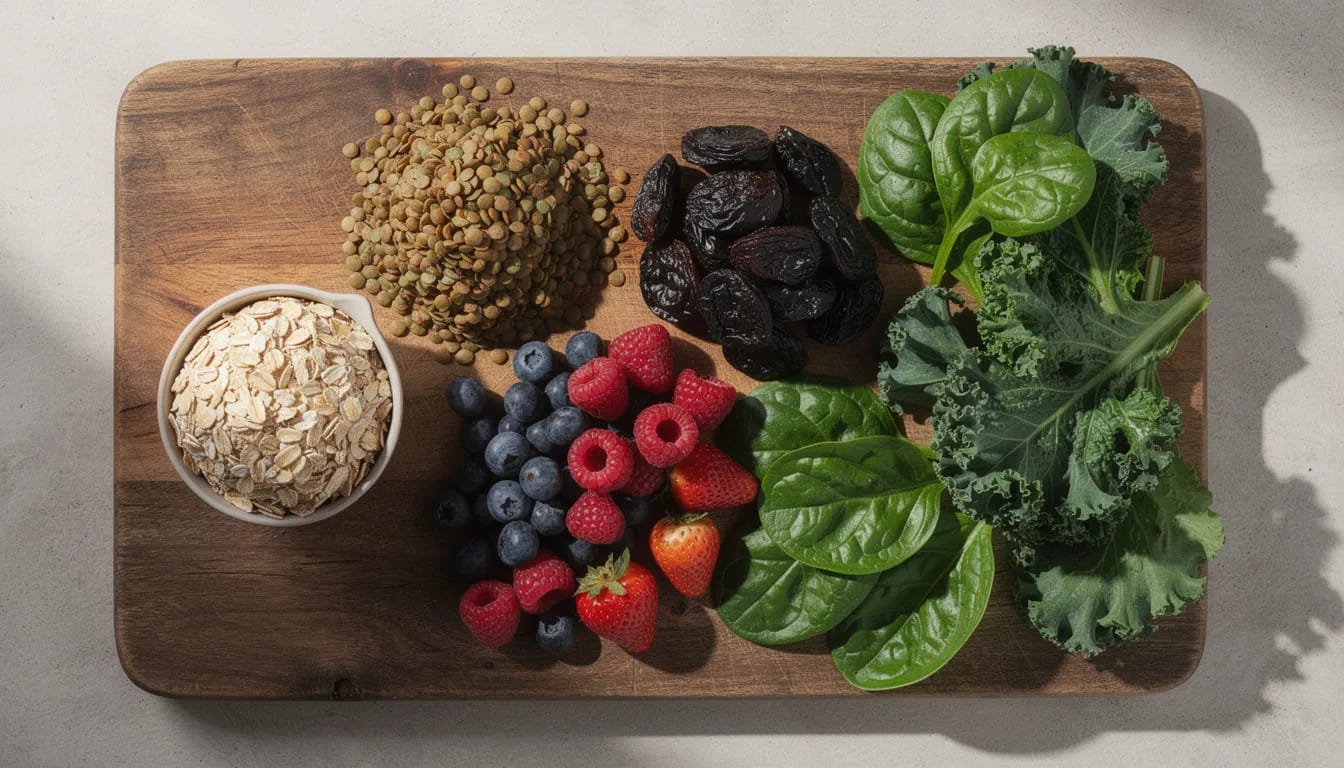
Food Category | Examples | Daily Target |
|---|---|---|
Fiber | Oats, lentils, flaxseed, raspberries, prunes, leafy greens, whole grains | 25-35 grams |
Fluids | Water, herbal tea, broth | 1.5-2 liters |
Fiber rich foods to prioritize | Prunes, kiwi, chia seeds | Several servings weekly |
Staying hydrated keeps stool soft. All the fiber in the world won’t help if you’re not drinking more water to go with it.
Movement matters:
- Regular exercise stimulates gut motility
- Aim for 20-30 minutes of walking most days
- Even gentle movement helps keep things moving through your colon
- A sedentary lifestyle slows down your whole digestive system
Build a bathroom routine:
- Create a regular “appointment” once or twice daily
- Best timing: 15-30 minutes after a meal
- Use your supported squat posture
- Don’t rush, but don’t scroll endlessly either
- Leave your phone outside
Relaxation techniques:
- Practice diaphragmatic breathing with a soft belly
- Imagine your pelvic floor opening like a flower (weird, but it works)
- Keep hands, jaw, and forehead relaxed
- Tension anywhere in your body can create tension in your pelvic floor
When to see a doctor:
- Constipation lasting longer than 3 weeks despite lifestyle changes
- Unintentional weight loss
- Rectal bleeding
- Pencil-thin stools
- Strong family history of colon cancer
If constipation persists, people can speak with a healthcare professional about medication that may help. Occasional constipation is expected, but pain every time you go isn’t and should be discussed with a doctor. Constipation may also be accompanied by other symptoms—if you notice other symptoms along with constipation, you should seek further evaluation.
Don’t brush off persistent symptoms of constipation as “just needing more fiber.”
Pelvic Floor Tricks and Supports for Easier Pooping
Here’s something nobody tells you: many people with constipation or incomplete emptying have pelvic floor muscles that do the opposite of what they should. Instead of relaxing to let stool out, they tighten up.
This is called dyssynergic defecation, and it’s more common than you’d think.
Visualization cues that help:
- Imagine your anus and pelvic floor dropping downward with each exhale
- Think “release” rather than “push”
- Picture the muscles widening and opening
- Avoid imagining anything clenching or squeezing
About “splinting”:
- For people with rectoceles or prolapse, applying gentle support to the perineum or vaginal wall during bowel movements can help
- Use a clean hand with folded tissue or a glove
- Only do this if advised by a clinician
- It’s a legitimate technique, not something weird
What to ask about:
- If you have pain during bowel movements
- Chronic difficulty starting to poop despite feeling the urge
- Sensations of blockage even with soft stool
- Pelvic floor physical therapy can address these issues directly
What NOT to do:
- Stop doing Kegels while trying to poop
- Kegels tighten your pelvic floor—the opposite of what you need
- Over-strengthening without addressing relaxation creates problems
Posture changes work best when combined with correct muscle relaxation. The best position in the world won’t help if your pelvic floor is gripping like it’s holding on for dear life.
Staying Informed about Digestive Health
Staying on top of the latest digestive health info is honestly one of the smartest moves you can make – like, seriously smart. Subscribing to a digestive health newsletter? That’s your secret weapon for staying in the loop about breakthrough research, those “why didn’t anyone tell me this before” tips, and expert advice on everything from your daily bowel movements to getting your pelvic floor muscles to actually cooperate. These updates can help you catch those sneaky symptoms of constipation or other bowel weirdness early, so you can tackle them before they turn into those “why is my body betraying me” situations that follow you around all day.
And hey, don’t be shy about reaching out to a healthcare professional when your digestive system is throwing its own little rebellion or you’ve got questions that Google just can’t answer properly. They can give you the personalized roadmap for managing constipation, teaching your pelvic floor to chill out, and getting your entire digestive game running like a well-oiled machine. By staying informed and jumping on problems before they get comfortable, you’ll be the person who actually prevents chronic constipation and other digestive disasters – keeping all those muscles and your whole system working so smoothly that your bathroom visits become the easy, predictable part of your day instead of some daily mystery adventure.
When Poop Position Is Not Enough: When to See a Professional
A toilet stool and a forward lean help most people, but persistent or severe symptoms need proper evaluation. Position is a tool, not a cure-all.
See a healthcare provider if you experience:
- New constipation after age 50
- Blood in stool (bright red or dark)
- Black or tarry stool
- Severe abdominal pain or discomfort
- Sudden change in bowel habits lasting several weeks
- Alternating diarrhea and constipation
Work with a professional if you have:
- Long-term laxative dependence
- Suspected irritable bowel syndrome (IBS) or other bowel disorders
- Inflammatory bowel disease
- Occasional constipation that’s become chronic constipation
Tests you might encounter:
- Blood work to check for underlying conditions
- Stool tests
- Colonoscopy (especially if over 45-50 or with red flags)
- Anorectal manometry to assess muscle function
Specialists who can help:
- Colorectal surgeons
- Gastroenterologists
- Urogynecologists
- Pelvic health physical therapists
These professionals can provide customized coaching on position, breathing, and muscle relaxation. They see poop problems every day—nothing you describe will shock them.
The bottom line:
Posture is a low-cost, low-risk tool that helps most people have better, faster, more complete bowel movements. But the best outcomes come from combining it with medical guidance when needed, attention to diet and fiber, regular exercise, and overall digestive health awareness.
Your bathroom doesn’t need to be a battle zone. Get your feet on a stool, lean forward slightly, relax your belly, and let your body do what it was designed to do.
And hey—if you want more practical tips on health promotion for your digestive system, subscribe to our digestive health newsletter. We promise to keep it as smooth as your next bowel movement should be.
Time to crown a new fastest pooper in the house.
Conclusion and Final Thoughts
Look, at the end of the day, getting your bowel movements right isn’t just about avoiding that “I’ve been sitting here for 20 minutes and nothing’s happening” nightmare—it’s about actually supporting your digestive system and feeling like a normal human being instead of someone who’s constantly bloated and uncomfortable. By ditching the standard toilet-sitting position and actually squatting like our ancestors did (or at least using one of those fancy footstool thingies), plus making some basic healthy choices that don’t suck, you can finally have those satisfying, complete poops that make you want to high-five yourself. And yeah, you’ll probably dodge the whole chronic constipation mess that makes you feel like you’re carrying around a brick in your stomach.
Don’t sleep on the power of actually knowing what you’re doing. Whether you’re the type who subscribes to those digestive health newsletters (you know who you are) or you finally bite the bullet and talk to a real healthcare professional about your bathroom situation, having the right info can be a total game-changer. When you’re on the toilet, here’s the magic: lean forward slightly, get those knees up higher than your hips, and rest your elbows on your knees. This position basically tells your pelvic floor muscles to chill out and stop being so uptight, making everything flow way easier and actually finish the job instead of leaving you wondering if you’re done or not.
Whether you’re dealing with the occasional “why is nothing happening” moments or you’re in full-on digestive crisis mode, taking charge of this stuff—through getting your posture right, staying informed, and not being too proud to get professional backup—can seriously transform your entire bathroom experience. Prioritize your digestive health like you would your WiFi connection (because let’s be honest, both are essential), listen to what your body’s telling you, and don’t be embarrassed to ask for help when things get weird. Your bowels (and honestly, your entire quality of life) will thank you for it.